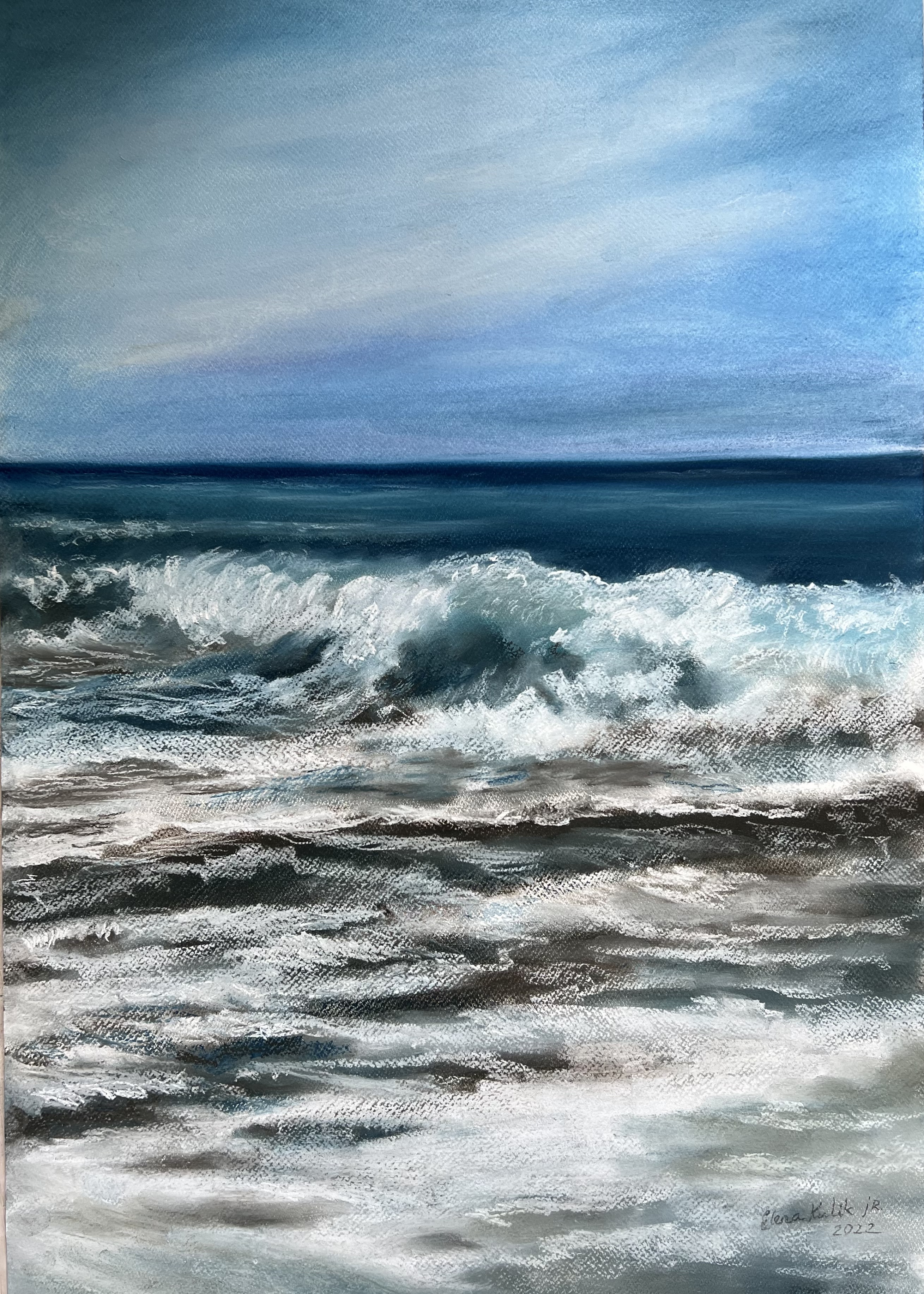
The sea as a space of freedom, energy and change.

Olena Kulyk Diril

Ukrainian Artist and Pastelist
Member of Pastel Artists.CA

25+Years of Practice
25+Personal Exhibitions
20+Countries with Works in Private Collections

About the Artist

A lifetime of painting the sea — exploring change, freedom, energy and eternity.

Olena Kulyk Diril is a Ukrainian contemporary artist based in Istanbul, Türkiye, whose artistic practice is deeply connected with the sea, light and the ever-changing atmosphere of nature.

With 25 years of professional artistic experience and 25 personal exhibitions, she has presented her work across Ukraine, Italy, Germany and Türkiye. Her paintings are held in private collections in more than 20 countries.

She has been drawing since she was two years old, and is the daughter of Olena Kulyk, a well-known Ukrainian artist. Working primarily in soft pastel — alongside various oil painting techniques — she explores the relationship between landscape and emotion, capturing fleeting moments of light, movement, silence and energy.

For me, pastel is not simply a medium — it is a direct connection between my hand, colour and the surface.
Selected Personal Exhibitions

  • National Reserve "Sophia Kyivska" Kyiv, Ukraine · 2009
  • Gallery "Il Collezionista" Rome, Italy · 2013
  • Nilüfer Municipality Bursa, Türkiye · 2018
  • Consulate General of Ukraine Hamburg, Germany · 2021
  • Yunus Emre Culture Center Istanbul, Türkiye · 2023
  • Consulate General of Sweden Istanbul, Türkiye · 2025
Olena Kulyk Diril

I have painted the sea throughout my entire artistic life. For me, the sea is more than a landscape. It is a way of exploring change, freedom, energy and the sense of eternity. The sea has existed for thousands of years and will remain long after us. Yet it is never still. Its light, colour, movement and energy are constantly changing. This contrast between permanence and change is at the heart of my work.

The Sea

A lifetime of painting the sea.

I have painted the sea throughout my entire artistic life.

I return to it again and again, not because it is familiar, but because it is never the same. The sea is always changing — its colour, light, movement, rhythm and energy shift from one moment to the next. Yet the sea itself remains. It existed long before us and will remain long after we are gone.

This contrast between permanence and change is at the heart of my work.

For me, the sea is more than a landscape. It is a space of freedom, movement and possibility. It has no fixed form. It can be calm or powerful, transparent or deep, almost weightless in the light or overwhelming in its energy. Sometimes it seems endless; sometimes a single wave becomes an entire world.

I am interested in these changing states.

When I paint the sea, I am not trying simply to record what I see. I am trying to capture a moment that cannot be held still — the way light touches the water, the movement of a wave before it breaks, the silence between two moments, the feeling of standing before something much greater than yourself.

The sea constantly reminds me that nothing remains unchanged.

A wave exists for a moment and disappears. Light moves across the surface and is gone. Colours transform with the weather, the hour and the season. Yet the movement continues. There is something deeply human in this: our own lives are also temporary, constantly changing, while the world around us continues.

Perhaps this is why I have never felt that I could paint the sea only once, or even hundreds of times. Each painting begins with the same subject, but each one becomes a different experience.

I am drawn especially to the moments when the sea is between states — when calm begins to change, when light breaks through clouds, when a wave gathers strength or, conversely, gradually becomes still. These are moments of transition, and transition is something I return to throughout my work.

Pastel allows me to respond to these states directly and physically. I feel the pigment against the surface and allow the movement of my hand to become part of the painting. For me, this physical connection is essential — I do not simply see the sea; I feel its movement, its energy and its changing surface.

Sometimes I work in oil and begin with a brush, but after a while I put the brush aside and continue painting with my fingers — even when working in oil. I am drawn to the direct contact between my hand, the pigment and the surface — a connection that allows me to respond instinctively to the movement and energy of the painting.

This is one of the reasons pastel feels so natural to me. It gives me a direct connection between my hand, colour and the surface — and allows the painting to remain physical, immediate and alive.

For me, painting the sea is therefore not only about depicting nature.
It is about time.
About movement.
About freedom.
About the feeling of eternity contained within a single changing moment.

The sea remains one of the few subjects I can return to endlessly — and still feel that I have not said everything.
Because the sea is never finished.
And perhaps neither are we.

Olena Kulyk Diril